Richard Gerver

Subscribe to Richard's e-newsletter

The Richard Gerver Blog

4 May 2013

CHANGE IS COMING

Richard Gerver @ 7:22 pm

CHANGE IS COMING

“To be successful, you have to be able to adapt to change.”
Sir Alex Ferguson, 13 times Premier League winning manager

Let me tell you, as an Arsenal fan, that quote hurts in just so many ways, but there we are!

To temper the hurt though, I have to confess that I am feeling a bit like a kid in the lead up to Christmas.

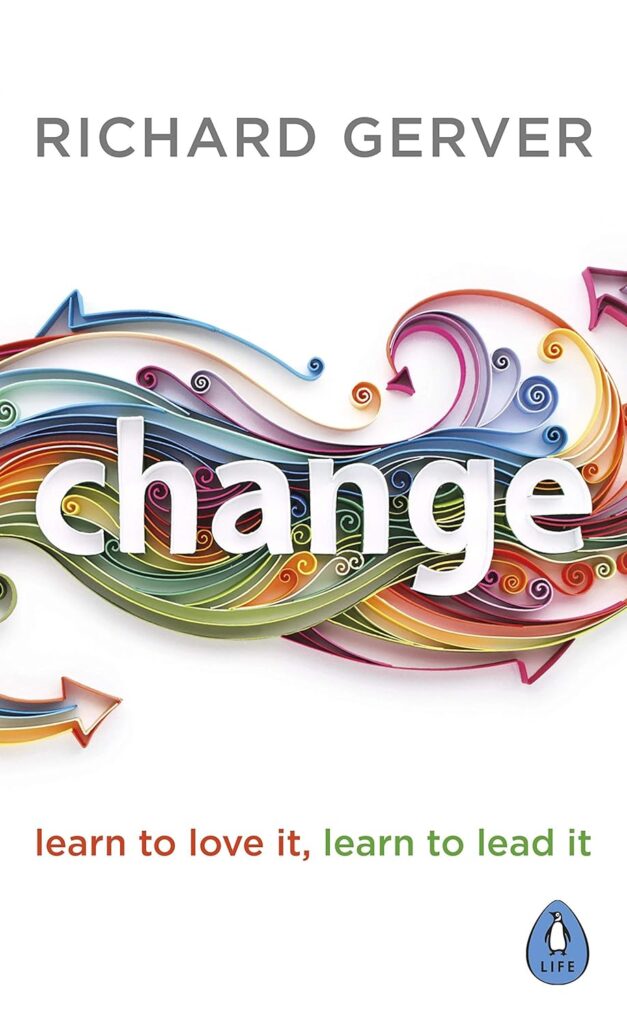
As some of you may know, I have a new book coming out next month – ‘CHANGE – LEARN TO LOVE IT, LEARN TO LEAD IT’. The book is in print and awaiting launch on the 27th June.

It is available for pre-order on Amazon

Change Graphic

Writing it has been a very personal experience for me, at times quite emotional. When I wrote my first book, ‘Creating Tomorrow’s Schools Today’, I was convinced it would be the end of my authorial career as I was convinced that I would have no more to say, so to see CHANGE in its finished form is a real buzz. I wanted to write about change from a very human perspective, to reflect on why change is such a scary thing for so many of us and how we can come to terms with it and even, perhaps, enjoy it. It is a book borne out of my own experiences and the experiences of those I have met and worked with; it isn’t an academic study or traditional self-help book, it is a book that I hope people will read, enjoy, reflect on and connect with on a very human level. I have tried to fill it with stories and events that will connect to normal people leading very real lives. For me our reactions to change are linked to our humanity and our emotions and that is what I have tried to evoke in the book.

I must confess that we have reached that slightly anxious phase in a book’s life; just prior to launch, when you can’t wait for it to hit the shelves but are nervous about handing something so personal over to the public arena.

I am thrilled that I will be formally introducing the book at the RSA in London on the Thursday 27 June

I will also be doing a very special event for The London Business Forum on Tuesday 8 October called ‘Who moved my Cheesecake’ where I will explore the themes of the book from a business and organisational perspective

There has been fantastic interest from the media about the book, including the in-flight magazine of a rather famous airline, all of which is just so exciting to all but my own kids, who just keep warning me not to embarrass them on the TV!

Over the next few weeks, I will be sending some “taster tweets”; quotes from the book to try and whet people’s appetites in advance of publication. As part of my lead up to the book launch, I want to hear from people about how they have changed their lives or their companies and would so love to hear your stories, some of which, I hope to post on my website in the coming months.

The time is so right to recalibrate the way we feel about change and I really look forward to doing that with you over the next few months.

P.S. I particularly hope that Arsene Wenger buys a copy, so that he can knock Fergie off his perch next season!

28 March 2013

TRUST THE TRUSTED!

Richard Gerver @ 4:25 pm

This month, I want to continue a theme from my piece a couple of months ago.

I had an interesting conversation with a UK Government politician this month at an education conference. He told me that I didn’t know what I was talking about when it came to the future of education. Now I am not arrogant enough to believe that my views aren’t flawed and I am certainly open to new thinking, challenge and development; but it was an interesting comment from someone who had never actually worked in education or in fact, anywhere near it. He told me education was about exams first and then, if there was time left after that, we could indulge in the “airy fairy nonsense” that I call, developing the whole child!

I have been captivated this month by the arguments flying around Westminster, about the future of press regulation and in the regular use of the words trust and professionalism that have been used to underpin all sides of the debate. I was interested in the argument for self-regulation and the need for a free press as a crucial foundation in a free society.
The reason for my on-going fascination with this self-interested and frankly sensationalist debate, is that it has taken place, largely inside the journo-political bubble; a bubble made up of the same people, many of whom move between the two realms; incestuously.

These same two groups have been seeking to tell us all that education is broken and more importantly that they and they alone know how to fix it.

Over the last couple of years in particular, the Government and their friends in the print media have been running a vicious, manipulative and at best, ill-informed campaign against educators and people with a real insight into the future challenges for our children; some of whom, incidentally, will be 22nd Century citizens.

They demonise anyone who argues against their view point, labelling and name calling; using all of their powers to make crass and emotive statements labelling anyone who has the temerity to provide a counter argument as ‘enemies of children.’

I remember a few years ago, having a scary experience with a journalist from one of the UK’s most popular newspapers, telling me at the start of a telephone interview, that unless I told her what she wanted to hear; in support of her views of education, she would proceed to “destroy my credibility and my career”, in her article.

These people are dominating our lives and trying hard to protect the political cartel of power, making it very hard for reasoned, honest and objective debate and discussion about the future of education to occur; leaving the public, ill-informed and our children frighteningly vulnerable.

Our Minister of State for Education, Michael Gove, has overseen the development of a new curriculum that has been rushed through and created by a group of partisan thinkers with a commitment to their own ideology. Despite his claims, he has ignored much of what the best systems in the world have to offer and nearly all of the leading voices in global education, preferring to manipulate facts and research in order to justify his own theories and ideology. Recently, 100 leading UK educators and academics published a letter detailing just why his curriculum reforms were so dangerous and damaging. Yet he will plough ahead using his rhetoric and friends in the ‘free’ press to continue to manipulate truths. I laugh when he is cited as the most transformative Education Secretary in UK history, a label given to him by his… yep, you guessed it!

Every year Ipsos MORI carry out a poll of which professions the population of British adults trust the most and the latest results published in February of this year, make for interesting if not unsurprising reading, given that the outcomes have remained largely the same for over 20 years. At the top of the charts are doctors with an 89% trust rating, followed closely by teachers with an 86% trust rating. At the bottom of the pile are politicians with an 18% trust rating with journalists just one place above them, with a 21% trust rating. Michael Gove is of course a politician, whose former career was as a… journalist.

We must all remember this as these people continue to undermine our professionalism, try to erode our trust in the public eye and by so doing, endeavour to block our ability to self-regulate and lead education; education, which is actually the most important foundation in any society, especially a free one; education, which must above all things, be focused entirely on our children, their futures and their freedoms, an education that must be free of the journo-political bubble and the rhetoric that goes with it.

As educators, we must trust ourselves and work hard to seize the trust of the public, in order to win the freedom to do what is right for our kids.

4 March 2013

THE MAN WHO CHANGED THE WORLD

Richard Gerver @ 12:13 pm

I am well aware that I am a lucky, lucky man; my job means that I get to meet many amazing people. A couple of weeks ago though, I met a man who has, quite literally, changed the world and I have to confess that I was in awe.

I was in Saudi Arabia, in Riyadh, for a conference on education and new technology. There was a fantastic line up of speakers and over 3000 participants, it was a big deal and shows just how seriously Saudi is taking the future of its education development.

I love listening to other speakers; I learn so much from their insights, their wisdom and their experiences and I was more than a little excited to hear the thoughts of the conference’s opening speaker. I was even more excited to find myself sat next to him in the speaker’s room before the event began and then to have time with him after the event both at the airport and indeed on our flight to London.

Steve, as I like to call him, was the co-founder of Apple; not Jobs, the other one, the one who actually designed the computer. Steve Wozniak, is a relatively shy and unassuming man, a gentleman actually, a man who, unless you knew, would pass you by in the street unnoticed, much like you or I; no show of wealth or status, no bravado or pompous airs, just a normal guy who has happened to change the world!

As a boy, he had two ambitions; one to be an engineer like his father, because he knew that engineers can make the world a better place; the other, to be a teacher; because, well… teachers too can make the world a better place.

Of course engineering won and the rest, as they say, became history but only because of the unique partnership that was born when Steve met Steve.

What I think struck me most about Wozniak was his extraordinary generosity and humanitarian spirit. It was apparent from his earliest days as an inventor He knew he was on to something when he started messing with valves, diodes and soldering irons and he knew that it was something that could lead to amazing things for his fellow man and woman but he also knew that he wasn’t very good at understanding the social impact of his inventions, so he would go to his local computer club and give away his ideas to people that he knew, would find uses for them; he just wanted to make stuff that made life better. It was only when Jobs became properly involved that Apple was born and a business created.

Steve has always instinctively wanted to do good; I asked him what he did with his time now and apart from still inventing, he said that he is in a very privileged place and that actually he was able to go around the place, trying to do good; this included spending a number of years after leaving Apple, working as 5th Grade teacher in a state school near his home; thus fulfilling his other ambition. He loves teachers, saying that they are, “special, special people”. He also believes that, “it is less important what you teach and more important how you learn.”

“Learning,” he says, “must be a personal journey.”

The more I talked to Steve, the more I liked him and the more I thought about how much he demonstrates exactly what the future needs and what we have to help to develop as educators.

He didn’t much like the school system as a child, it restricted his thinking and forced him to study stuff he found totally irrelevant. Once free of the formal and conforming shackles of the school system he was, through unique collaborations and stimulus, able to change the world!

I have met so many enterprising, young entrepreneurs recently, who have chosen to forgo the traditional routes of university and college to strike out on their own and create products that they believe can also change the world. The more I see, the more I am convinced that standardised systems and routes of learning will increasingly hamper our children’s futures and I have to say that I have far more faith in the lived wisdom of a guy like Steve than that of the limited rhetoric of our politicians.

Like Steve did before them, many of our young engineers meet at events called hackathons where together they share thinking, skill and ideas to find new solutions to old problems; exciting meetings that celebrate the ingenuity and creativity of the human mind.

Maybe, just maybe, we should convince Steve to lead a massive hackathon to find the solutions to the future of our education system and yet again… change the world!

1 February 2013

TRUST

Richard Gerver @ 2:05 pm

In England at the moment there is ferocious debate about public sector performance and effectiveness. There has been a sickening amount of media and political driven nonsense about lazy and ineffectual teachers and health sector workers in particular and as a result, policy is creating increasingly punitive ways to drive and punish; including the development of rigorous performance related pay systems and behind that high level target setting.

Forgive me but I have bitten my tongue for long enough and need to get my own feelings off my chest.

Firstly; the vast majority of people who work in health and education do so because they are passionate about serving the needs of the people who rely so heavily on those services. I have worked in education for the vast majority of my adult life and very rarely have I come across anyone who chose to work in that field for the money or for any other reason than the joy of helping others to develop as people and as learners.

Sadly, policy and media commentary is too often designed by people whose own ignorance and lack of life experience, prejudice what could and should be constructive and productive debate and development. There are a number of dangerous and false assumptions at play and they need to be challenged. There is an unfounded assumption amongst the political classes; across the spectrum of political power, that teachers, doctors and nurses are intrinsically lazy and will endeavour to get away with the bare minimum unless they are threatened, challenged or put under pressure to perform. Ironically whilst the law of any free society, states that you are innocent until proven guilty, political perspective takes the opposite view of its public servants.
I guess that one of the real problems is that the vast majority of senior politicians have never lived outside of the political bubble; very few have worked in a school or a hospital and most media commentators have been cut from the same cloth as those controlling policy.

Teachers don’t teach to get rich; doctors don’t cure the sick in order to have the money to buy fast cars or tropical islands, neither do they choose such emotionally and physically challenging vocations because they want an easy life! They do it because they are drawn by the need to serve others and they derive their greatest satisfaction from so doing.

I don’t deny that there are exceptions and that sometimes, the self-interests and adversarial nature of some public sector unions don’t help; they are guilty of protecting some who perform badly and don’t live up to their responsibilities but the problem with policy is that it is too often designed for the lowest common denominator and as a result, that impacts on the potential growth of the majority.

If they have in fact ever had a proper job, many senior politicians will have worked in traditional industry; industry driven by productivity, unit cost and efficiency and they therefore try to apply traditional industrial principles to a world that is not about conveyor belts and production lines. Children and patients are human beings; delicate and organic; each being original, gloriously unpredictable and well… human! We are not machines, products or decimal points on spread sheets and as a result many, many uncontrollable factors can impact on the education or treatment of children and the sick.

Performance related pay, that is bound to the greatest extent, to purely data driven outcomes that are about simple uniform productivity, will not improve how well educated or how healthy our populations become; the irony actually, is that by driving that system across these sectors you will only create glass ceilings and prevent the true realisation of potential achievement. It is human nature to work towards fixed targets, that is after all, what traditional schooling trains us to do; why, because it is built on the traditional industrial model.

Educators and health workers need to be able to do their jobs in more organic and innovative ways; responding to the needs of the individual; of the person, not of a product.

Should we be able to hold them to account, absolutely; they have responsibility for the wellbeing of society itself but we must move the debate in a different direction.

We must be more optimistic and develop, collaboratively, policy based on supporting the highest common denominator; policies that aren’t punitive first but are productive first; otherwise we simply refine service to meet the needs of targets rather than design service to meet the needs of people. We must also learn to trust our educators and health workers ahead of our politicians and headline writers; after all teachers and doctors will be there to serve us for their entire working lives; determined to save and empower others’ lives can we really say the same about a political system overrun by spin and media control?

21 December 2012

Fight for Humanity

Richard Gerver @ 10:42 am

I am assuming that if you are reading this, the Mayans were wrong and we made it beyond the 21st of the 12th 2012… just. The last couple of weeks have been tragic, a reminder of the fragility of the human flame that burned so brightly over the summer of sport and celebration.
2012 was to be the year when the world’s youth had brought hope and wonder to our beleaguered planet; cutting through the economic, environmental and socio ethnic strife to give us a timely reminder of the potential of people and the optimistic potential of our species that only comes on such a scale, every four years, when the Olympian flame burns bright in our consciousness. The extraordinary feats of human endeavour and achievement exemplified by super humans such as Usain Bolt, Jessica Ennis and Bradley Wiggins and of true heroes like Martine Wright, who overcame the terror of a fanatic’s bomb blast on 7/7 to triumphantly represent her nation in the Paralympics.
Yet here we are, still in shock, just days after the evil slaughter of 20 young, innocent children and 6 selfless, dedicated educators, wondering on our own humanity.
It reminds me of the story I first heard in Australia earlier this year, of Walter Mikac, who lost his wife and young daughters at the Port Arthur massacre in April 1996; a man who used his grief and experience to drive forward the Australian gun law debate in order to create a meaningful legacy out of such profound tragedy. His is a story of what makes us, as a species, beyond all the evil and incomprehensible acts, special… His is the demonstration of what makes the best of us; our humanity.
Sadly, the Newtown massacre will not be the last test of our kind; it will not end evil or tragedy on our planet; would that it did. It is however a point at which to reflect on so many things as we head into another year, another page of human history.
It strikes me that it is the desire of some of our kind; to control, to use power to drive their own self-interests, to manipulate and to protect their own insular positions that causes so much of our suffering; be it pro-gun lobbies, big business, politicians or elements of the media and it is always the humanity of real people that shines through; picks up the pieces and tries to heal the wounds.
As 2012 comes to an end and we reflect on what will surely be a major one in our history, we must remember that above all things it is the humanity in the majority of us that is worth nurturing, fighting for and ultimately celebrating. It is the teachers who rushed to the protection of those terrified youngsters in Newtown, the doctor who fought through the smoke and chaos and rushed to the aid of a stricken Martine Wright, the Walter Mikac’s, who through the fog of grief, still cling to the belief that good must win out and that our legacy must be a positive one that reminds us that it is never systems, structures, initiatives or policies that bring out the best in us but it is our very humanity.
As an educator, I hope that you will forgive me, if I reflect on what this means to us all as we hug our children closer this yuletide and think about their future, their legacy and their tomorrow. Those of us that have a responsibility for that future must remember that their future will not be determined just by the academic; the controls, certificates and data but by something far, far more profound; it will be determined by their humanity and that it is that, above all things, that we must fight for; nurture, value and protect.

29 November 2012

Richard Gerver @ 10:13 am

Well I’ve had an interesting few weeks, the highlight of which may well be the English Secretary of State for Education, Michael Gove’s declaration of love for French lesbian poetry. Usually, this kind of headline would bring a wry smile to my face but not on this occasion; it was a remark made during a speech in defence of examinations. The headline overshadowed a far more real and worrying remark that, in his opinion, exams were primarily important because they were the best way to motivate children in school. I am not sure I have ever heard a more ignorant and ill-informed statement with regard to schooling….ever!

Compare it to the statement coming out of China recently from their new leadership, about the future of Chinese education. They have committed to a radical transformation of schooling because in their own words, China’s future depends on discovering and nurturing the next generation of people like Steve Jobs. In what was quite an extraordinary demonstration of honesty and insight, they recognised that their hugely efficient and traditional system was simply not geared up to do that. There, in a nutshell, is just why politicians like Gove have got to wake up fast to the reality that perfecting the existing system is simply not an option. If the 1.3 billion people in China do gain access to a system promised by the new vision, then we are all in trouble; particularly if we don’t shift and shift fast.

Earlier in November I was invited to be part of a quite extraordinary event in Los Angeles, an event that was created and realised by a quite extraordinary American teacher, Chris Thinnes, Academic Dean at Curtis School. On a warm and sunny Saturday he brought together nearly 700 educators and parents to work together with some of the most brilliant educational minds in the world; Carol Dweck, Nikhil Goyal, Ken Kay, Alfie Kohn, Steven Jones, Wendy Mogel, Sir Ken Robinson, and Yong Zhao, to draft a covenant; a promise to the children in their care, a vision for the future of their education. You can see highlights of the event at

http://www.curtiscfee.org

It was an inspirational day and yet another demonstration that education, if led by the right people, has a dynamic and exciting future, a future which will see our children brilliantly prepared for the challenges of their future.
The covenant (C.H.I.L.D.) itself is still evolving and can be viewed in full at the above site. The process was inspired by three articles from The United Nation’s Convention on the Rights of the Child:

Article 28 asserts “the right of the child to education” that is “accessible to every child” and “administered in a manner consistent with the child’s human dignity.”

Article 29 confirms that education should be directed to “the development of the child’s personality, talents, and mental and physical abilities to their fullest potential,” to “the development of respect for the child’s parents, [and to] his or her own cultural identity, language and values,” and to “the preparation of the child for responsible life in a free society.”

Article 31 affirms “the right of the child to rest and leisure, to engage in play and recreational activities… and to participate freely in cultural life and the arts.”

These statements proved to be provocative stimulation and provide what I believe are powerful reference points as we seek to audit and reframe our own practice as educators. I also believe that they are articles with which we should hold our policy makers to account. I fear that Michael Gove and others like him have lost sight of our children and their rights, as their political obsession with structures, systems and fixed data outcomes continue to drive their thinking, rhetoric and policy.

We are coming to the end of yet another 21st Century year, a year which has seen even more uncertainty, disaffection and distress for so many. One thing we all agree on, is that the future is dependent on education, the right kind of education; systems that can only be developed out of collaboration and a commitment to the rights of our kids.

I urge anyone with an interest in the future to convene meetings to discuss and act upon the issues raised in articles 28, 29 and 31 and to create a commitment similar to or part of C.H.I.L.D.

2013 must be the year that we stop waiting for policy makers to define our educational actions, it must be the year that we stand firm, seize back the rights of children and enact a system that ensures that our kids aren’t looking at China with envy and regret. Great education isn’t about exams; it’s about vision, values, empowerment and the future.

23 October 2012

Help the Hospices

Richard Gerver @ 9:17 am

It was the start of summer 2008 when my agent Brendan Barns phoned me in my office to ask the question.

“Richard, I am putting a team together to raise money for Help the Hospices and we are going to run the London Marathon in April… are you interested?”

I was taken aback; flattered to be asked and a little scared at what it would really mean to say yes. He had caught me at a good time though, I was just about to turn 40 and had started composing my bucket list!

“Yes, go on then, I’ll do it.” The words came out before I could censor myself, probably the best way, especially considering that I hadn’t run anywhere for more than 20 years. In fact, as a kid at school, I used to break up the cross country runs with a shifty cigarette with my friends after every walked mile. I believe that I actually broke the school record for the slowest finish in history.

There was a moment’s silence at the other end of the phone following my reply; it went on just that second too long and then came the response, “really?”

It turns out that Brendan had been recruiting for a while, the problem was, he had gone down his list and I was the first to say yes… I was the last name. His disbelief was understandable given my size; all of that hidden muscle, camouflaged by layers of cosy winter insulation.

So it came to pass that I trained, got into shape and ran; well jogged; well crawled around the 26.3 miles on an unnaturally hot April’s day in 2009 in just over 5 hrs.
At first, I accepted the challenge as a personal thing; something to tick off my list, but as I started to raise the money for Help the Hospices and started to really understand the incredible work they did, my motivation changed. I remember thinking to myself as I ran for mile after mile, day after day around the streets of Derby, especially in mid-winter in the rain and snow; that it was more than worth it and that I just hoped that the hospice movement would be there if ever I needed them.

By the time I crossed the finish line, just behind an eight foot pink inflatable nurse and a giant Shrek donkey, I knew two things; firstly that I never wanted to run again and secondly that Help the Hospices was going to be my charity for the rest of my life.

Keeping the first thought has been easy and thanks to the latest phone call from Mr Barns, the second is still true too.

“I’m doing another fundraiser for Help the Hospices,” he said just before this summer started. I went into a cold sweat; memories of blisters, chafing bits and knee pain flashed back all at once.

“Do you fancy…” I was feeling sick at this point, already knowing that I wouldn’t be able to say no but wondering if the rules would allow me to do it on a Segway.

What I heard next wasn’t just music to my ears; it was like warming liniment on my skin. “I’m hosting a Funny Business comedy night at The Comedy Store in London in December. I want to get some of our speakers to do a short stand-up comedy slot for a fund raising night. Are you up for it?”
I was so relieved that I hadn’t heard the words; run, marathon, pain! That “yes!” spat out like a reflex of relief.

At the time, it seemed that it would be so easy; no training, no wet, dark, cold mornings on the streets; just a nice warm, intimate venue and a few knock, knock jokes!

As we are now just a month away, I am thinking I’d rather run another marathon! When I told people 4 years ago, that I was going to run the marathon, they would raise an eyebrow but show encouragement. “Good on you,” “Good luck; it will be an amazing experience.”

All I hear now, when I tell people about the Comedy Store is: “Really? That’s gonna be tough… tough audience that one!” “Are you sure? I mean, can you be funny?”

Just writing this is making me feel a little queasy…

So it is; that I come to the point of my letter this month.

HELP! I need friends in the audience, people who will laugh; in the right places and help me to Help the Hospices and the extraordinary work they do for all of us.

If you have some time on the evening of December 3rd and can get to the famous Comedy Store in London, please come along, show your support, have a laugh and help us raise some serious money… after all, unlike cheering on the London Marathon from Tower Bridge, there will be a warm seat, no chance of rain and plenty of booze!

4 October 2012

Colombia; collaboration and hope

Richard Gerver @ 10:59 am

It has been another extraordinary month for me; I have travelled nearly twice around the world having had the privilege to work with carers in Sydney, college lecturers in Portland, dentists in London and also with senior leaders at the BBC, all have been enlightening and stimulating experiences but I have to confess that nothing compares to my recent experiences in Medellin, Colombia.

I was invited to travel to Colombia by Fundacion Telefonica to participate in a global conference exploring the future of the education system. During my time though, I got to meet senior business leaders in Colombia’s second largest city as well as educators from across Latin America. I also had the inspirational experience of visit a communa high in the hills above the Medellin basin. I saw remarkable evidence of community collaboration as the tool to transform societies and heard fantastic individual stories that serve to demonstrate the limitless potential in this part of the world.

My first contact was with a man mountain called Dorian, the man assigned to look after me during my visit; part driver, part security detail, I wouldn’t have argued with him, in fact, I was glad he was on my side. His story summed up the drive to achieve that is sweeping across central and South America. As a child he had emigrated to the US with his family but was forced to return to his home town when he came of age because of problems with citizenship, at the age of 38, he was now working his way through law school, using every minute of his spare time to study, whilst holding down a job that as far as I could see, began at 7am and could go on well into the night. In order to get to law school, he had spent many years, revisiting education in order to tool himself up for the challenges ahead. Although he was unlikely to qualify until he was 42, he was focused and highly committed. He wants to study administrative law in order to help others who were going through similar turmoil to that which he had been a victim of. I also met Cesar, who worked as my translator; a man who had spent most of his adult life in the US marines but had now “come home” in order to be part of Medellin’s rebirth.

Since I have been home, people have asked me to explain what I had seen and I guess that it can be summed up in just a few words; pride, passion, determination and drive to fulfil a powerful, shared vision for a city’s future.

This is best illustrated by the most moving experience of all which was a day long visit to the communa, in the hills overlooking the city. A communa that had for most of its recent history, been under the oppressive control of Pablo Escobar, the infamous Colombian drug lord, who died in 1993. The deprived areas he dominated were divided, lethal places to live; areas where people felt disenfranchised, devoid of hope and disconnected from society. A place where a mountain stream defined conflicted boundaries, which by merely crossing could spell death. Gang culture and fragmentation was rife. As his reign of terror came to an end, Medellin developed a new vision, it wanted to become a Latin American powerhouse, a centre for innovation and enterprise but as a city, it realised that it would need to transform the internal vision before projecting outwards. What it is achieving as a result, is remarkable.

I found myself stood in a torrential rainstorm in a street on the slopes, with rocks, carts and debris sweeping past me as the rain gathered to form rivers in the crude roads. Next to me was a remarkable building, designed and developed by top architects; a state of the art, aesthetically stunning, community centre; the heart beat of a community renaissance. Local people valued the facility so highly that there was no litter, no graffiti, no damage, just a beacon of hope and rebirth. Experts in education, healthcare and culture had come together and were working to train the community itself to deliver new services for the area and as a result; this collaboration had drawn people together with a new sense of pride and purpose; inspirational to see and experience.

Slightly higher in the hills, I was taken to a school to be shown their wonderful new classroom, filled with cutting edge technology courtesy of the Fundacion Telefonica. Here I met a group of young teenagers, all of whom had lives unimaginable to most of us but who were engaged and focused on their education thanks to skilled teachers who had provided learning opportunities rich in experience and context. The students had been taught web design and were constructing websites in order to communicate issues that mattered to them and that they wanted to share with the world; nothing frivolous here. The students were creating sites about teenage abortion, sexual abuse, drugs education and emotional wellbeing; this was real, raw and powerful learning at its best; engaging, relevant and transformative. This wasn’t about top universities or academic qualifications, this was an education for life built around empowerment, aspiration and values; the same vision that bursts from every part of the city; from the jagged rocks in the hills to the gleaming new buildings in the heart of town. It’s working too; Medellin has attracted the likes of Hewlett Packard and Telefonica to invest in new business, others are following fast, able to see the incredible potential for growth and development in this stunning part of the world.

As I returned to the UK in the heart of the political soundbites and posturing of the party conference season, I find myself strangely angered by the superficial nature of it all and yearn to be part of something as profound, as powerful as real and as revolutionary as what I saw in Medellin; real vision, real values, real action through a commitment to empowerment and collaboration; surely this is a lesson for us all.

11 September 2012

Sorry Mr Bolt!

Richard Gerver @ 11:42 am

What an extraordinary summer it’s been; the Olympics and Paralympics… Shades of Grey (I saw you reading it on the beach!)

It has also been the summer when events in the English education system have underlined just why investing all of our focus and energy in outcomes, fixed systems and data can be so damaging.

Imagine if, on that glorious summer’s night in early August, as Usain Bolt had crossed the line at the end of the hundred metres, highlighting to the world what humans can achieve through the identification and nurturing of talent, that as he dipped his formidable frame; as he pushed for the finish under the glow of the Olympic flame; as he flung his arms in the air, leant back and struck that famous pose, an official in uniform had approached him, apologised most profusely and told him that he had not yet finished the race because half way through his nine and a half second fleet footed journey, the International Olympic Committee had decided to move the finish line a further 10 metres down the track because too many of the eight finalists were breaking the 10 second barrier, meaning that the race had become too easy. They were very apologetic; they knew that he had spent 4 years training for this race; perfecting his strategy, his stride length, his muscle memory; pushing his body to breaking point day after day so that he could move through that hundred metres and give himself the very best chance of meeting the expectations of millions around the world, to ensure his own place in history and to achieve his dream, but they had to act because the system had decided. There would have been universal outrage!

On 23 August 2012 thousands of young people in England waited nervously for the results of their GCSE exams, they had worked hard; a bright generation, determined to make their mark, to achieve their potential, to open the door to the next stage in their lifelong journey; my daughter was one of them. So imagine how some of them felt when they opened those results to find that despite doing everything that had been asked of them and achieving the marks that they had been told they needed in order to pass well, they were informed that some faceless bureaucrat had decided, despite the race being nearly run, that they would shift the finish line because they didn’t like the fact that so many were crossing on or ahead of schedule.

My daughter was lucky, but one of her best friends was not; she is an intelligent vivacious young woman; conscientious and hard working who was desperate to do her best, and she had, she achieved the original pass mark by some distance, the one she had been set to aim for, only to be told that she had now failed because her efforts fell short of the new benchmark. As a result, she lost her place in the 6th form and had to completely reassess her future. I have to confess that if I had been in her position, I think that I may have told the system to go to hell; at 16 her efforts, her ambitions, her belief in the fairness of the system, had been punched right in the gut and why? To meet the needs of some grey person in a grey building in Westminster; in some room of political pain, where politicians and civil servants whip us with rhetoric, systems, policies and data in an effort to prove an ideological point.

The problem with education over the years is that it has become obsessed with systems and structures that are focused only on exam results that provide data; Governments have become blinded by some spurious league table produced by various international organisations, that apparently rank countries by how well educated their children are. Policy makers have decided that meddling with who runs schools, how they should be funded, what they should be called has been the way to address the problem; all in the name of national vanity; to climb a non existent medal table, so that policy types can puff out their chests and talk about how they saved their country’s children… We must stop this nonsense now!

Education is about people not systems, it is about the realisation of an individual’s potential and the celebration of human achievement, it is about finding the passions and ambitions that lie at the heart of each of our children and by tapping into to them, pushing our kids to do everything they can to maximise who they are and what they are capable of. By focusing on fixed outcomes and treating our kids like production line mouldings who can be manipulated by turning a dial, or varying the speed of a conveyer belt, we are depriving them and our society of any real chance we have to evolve, innovate and accomplish new and remarkable feats, so let’s please talk about children, learning and life; let’s create an education system worthy of our kids and then decide to hold it to account, rather than creating outcomes and then deciding how to meet them, after all not everyone is forced to run the 100 metres; Mo Farrah had different talents and was therefore given different goals and that’s why it wasn’t just Usain who achieved his dreams under that stunning flame, during that amazing summer, moreover, they were told how long their races were and they crossed the finish line, in the place it had always been; the place they had worked so hard and focused on.

4 July 2012

In Recognition of the Teaching Heroes

Richard Gerver @ 11:43 am

As the school year comes to an end and people turn their thoughts to the break and that oh so important time to recharge and refresh, I want to spend a little time thinking of those who are coming to the end of their professional journeys and are about to retire.

A week or so ago, I went for a drink with Les, he will mean nothing to you, but he is a man that has had an extraordinary impact on me. As we sipped that first beer of the evening, he calmly looked over to me and said, “Well, I’ve finally done it, I am retiring at the end of the year.” I felt strangely emotional, partly because I knew how much the job had meant to him. Les was the Assistant Principal at Grange; he had been for many years before I became Principal and had continued to be long after I had left, in fact, he had devoted the best part of 40 years to Grange; all of his working life. Through the many ups and downs the school had experienced in his long tenure, he had never wavered; his commitment to the school, the community and the children has become something of legend in the area.

I remember the first time that I met him. It was 2001 and I had just been appointed as the new Principal and I have to confess that I was wary of him; he was the school’s ‘alpha’ teacher; already an institution, he was strong minded, charismatic and popular with children, parents and staff. He had developed a fearsome reputation in the wider education community as a man who would not suffer fools gladly. I knew when I started, that he was the first person I would need to meet one to one.

The meeting went well, very well, surprisingly well; given that I hadn’t slept the night before. Les and I were, on the surface, completely different people; his experience had helped him to become highly pragmatic and I was a dreamer, but in the meeting he was immediately supportive and encouraging. As it turned out, this was extremely important when it came to building capacity and momentum for the changes that followed.

I remember on my last day at Grange which, as you can imagine, was a very emotional day, we shook hands and looked into each other’s eyes with pride and mutual admiration, as we did so I asked him the question that I had been bottling up since that very first meeting; “How come you were so supportive so quickly?” His answer was simple and typically to the point, “The first time you opened your mouth”, he said, “you demonstrated that you cared about Grange’s kids; my kids and that meant you were going to be alright by me!”

He was right of course, and I knew that that was exactly why the feeling had been mutual. He along with the rest of the remarkable team had been under pressure for years to deliver systems; to satisfy local government officials, school inspectors and examiners, it had been a very long time since anyone had talked about the children as people and not statistics but our time together was different and that meant that he was able to rediscover his passion for the job, the children and a school that he had devoted most of his life to.

I have worked in a number of schools in my career and with some great people; truly brilliant, skilled professionals, but I have never worked with anyone like Les; a man who must have been class teacher to nearly 1500 children and thousands more that he would have worked with in the many extra-curricular clubs and trips he organised and ran; which he did for no extra money or acclaim.

Every day he would arrive at school with the same energy and enthusiasm he did on his first day in the mid 1970′s.

He was not a man who ever looked for attention or public recognition because for him, the children and the smiles on their faces were what got him out of bed in the morning and made the job the most magical on earth!

It was no accident that he always got the best out of the kids; academically, socially and creatively; he oversaw the unbelievable rise in academic standards that had Grange moving from the bottom 5% of schools to the top and he delivered year on year. The true gauge of his influence though, was that every child wanted to be in his class, just as their parents had when they had been pupils at Grange!

Not only did he nurture the kids but he also guided many new teachers; supporting and encourage them to take risks, to focus on the children and to never let go of their passion for the job. I felt it first hand; despite me being the Principal, he became my rock without ever undermining my authority or making me feel like his junior.

We had strong discussions and debate, which is healthy and hugely productive; especially when they were as constructive and as focused as ours. They would always end with better ideas and strategies; true collaboration.

I know that there are many like Les around the world; true heroes of education who go through their careers giving everything they have for our children and then they head off into the sunset, often unnoticed, but today I want us all to celebrate those people; their professionalism, dedication and passion; their undying loyalty to kids everywhere. Not only has my life been richer for meeting a Les but so has that of every child, teacher and parent that he has worked with.

So here is to you Les and to all of those like you; your lessons will be active long after you leave the classroom; thank you!

Next Page »

Powered by WordPress